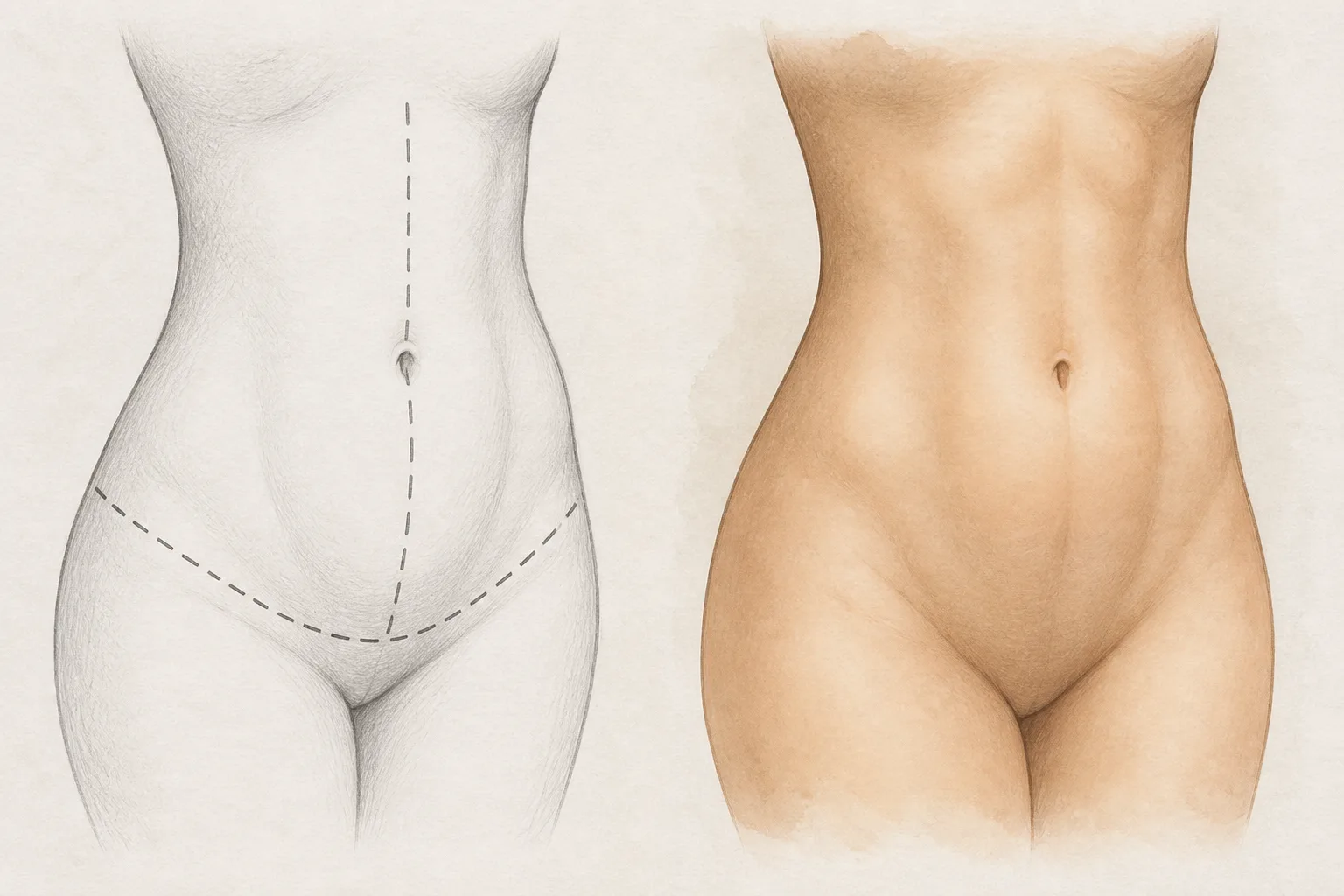
The right comparison starts with your abdominal anatomy
When patients search for mini tummy tuck vs full tummy tuck, they often expect the smaller operation to be a simpler version of the larger one. The more useful question is which area needs correction. A mini tummy tuck is generally designed for selected concerns below the belly button. A full tummy tuck can address excess skin and abdominal wall laxity above and below the navel. Neither option is automatically better.
The terms can also be used loosely in online package descriptions. A surgeon should examine the location of loose skin, the quality of the tissue, the abdominal wall, previous scars, fat distribution and your goals. The tummy tuck in Turkey operation page gives the broad treatment context; this article explains the practical differences to discuss in consultation.
What a mini tummy tuck usually addresses
A mini tummy tuck is commonly considered when lax skin, a small lower-abdominal bulge or limited muscle laxity is confined below the navel. The incision is usually shorter than a standard full tummy tuck and is placed low on the abdomen, often near the bikini line. The surgeon may remove lower-abdominal skin and may tighten part of the abdominal wall when appropriate.
Because the work is limited to the lower abdomen, a mini procedure usually does not correct loose skin above the belly button. The belly button is generally not repositioned. If the upper abdomen is the area that still looks rounded or the skin hangs across the whole midsection, a mini operation may leave the main concern untreated.
What a full tummy tuck can address
A full tummy tuck, also called a standard or traditional abdominoplasty, is designed to address the broader abdominal wall. It can remove excess skin from the lower abdomen, tighten or repair weakened muscles when indicated and bring the upper abdominal skin downward. Because the skin is repositioned, the surgeon commonly creates a new opening for the belly button.
The lower incision is usually longer than a mini-tummy-tuck incision, although the exact length depends on how much skin needs to be removed and the shape of your body. A full tummy tuck may be more appropriate after pregnancy or substantial weight loss when loose skin extends above and below the navel.
Mini tummy tuck vs full tummy tuck: the key differences
Treatment area
The mini procedure is limited mainly to the area below the navel. The full procedure addresses the wider abdominal skin envelope and may improve the upper abdomen as well. If the problem crosses the belly button, ask why a limited operation would be enough.
Belly-button changes
A mini tummy tuck generally leaves the navel in its original position. A full tummy tuck may require the surgeon to bring the navel through a new opening after the upper skin is repositioned. Ask to see where the scars and navel are expected to sit on your body, not only on a generic illustration.
Muscle repair
Some mini tummy tucks include limited muscle tightening, but they cannot automatically repair laxity across the entire abdominal wall. A full tummy tuck may allow broader access to separated or weakened muscles. Muscle repair can affect coughing, standing, lifting and exercise during recovery, so it should be named explicitly in the written plan.
Scar and recovery
A mini tummy tuck usually involves a shorter incision and may have a more limited recovery, but “mini” does not mean risk-free or trivial. A full tummy tuck is a larger operation with more tissue movement and often a more demanding recovery. Individual healing, combined liposuction, drains, smoking, health and support at home can matter more than the label.
When liposuction changes the conversation
Some patients have fat deposits as well as loose skin. Liposuction may be discussed with either a mini or full tummy tuck, but it does not turn one procedure into the other. Liposuction removes selected fat; it does not repair separated muscles or remove a hanging layer of skin. The surgeon should explain what each part of a combined plan contributes and whether staging would be safer.
If your skin is relatively firm and the main issue is a local fat deposit, liposuction may be enough. If the skin has lost elasticity, fat removal alone may reveal or worsen the appearance of laxity. Ask which problem is being treated before accepting a combination because it appears in a package.
Who might be considered for each option?
- Mini tummy tuck: selected patients with relatively limited loose skin or bulging below the navel, stable weight and realistic expectations about the upper abdomen.
- Full tummy tuck: patients with excess skin or abdominal wall laxity extending above and below the navel, provided health, timing and recovery support are appropriate.
- Neither yet: someone still losing substantial weight, planning pregnancy soon, using nicotine, needing medical optimisation or expecting a scar-free result.
These are broad patterns, not a self-assessment tool. The tummy tuck candidate guide explains the health and timing questions that apply to both options.
Questions that prevent a confusing consultation
- Where exactly is the excess skin or muscle laxity on my abdomen?
- What would remain untreated after a mini tummy tuck?
- Will my belly button be repositioned?
- Will muscle repair be performed, and across which area?
- How long and visible might the scar be on my body?
- Would liposuction help, and does combining it change the risk or recovery?
- What is the plan if the surgeon finds that the smaller operation cannot give a safe, balanced result?
Do not choose by incision length alone
A shorter scar can be appealing, but choosing a mini tummy tuck when the upper abdomen also needs treatment may lead to an incomplete result. Choosing a full tummy tuck when the concern is genuinely limited may expose you to more surgery than necessary. The appropriate operation is the smallest procedure that can reasonably address the actual problem, not simply the procedure with the shortest brochure description.
The ASPS comparison of tummy tuck types describes how skin location, muscle laxity and the extent of correction influence the choice. The NHS guidance also reminds patients that abdominoplasty is major surgery with risks and a recovery period to plan.
Takeaway
Mini tummy tuck vs full tummy tuck is not a contest. It is an anatomy and goals question. Ask the surgeon to map what will be corrected, what will remain, where the scars and navel will sit, whether muscle repair is needed and how the plan changes your recovery. Once those answers are clear, the procedure name becomes much easier to understand.