Start with the problem, not the procedure name
When patients compare Lipo 360 vs tummy tuck, they are often comparing two labels for a problem that has not yet been clearly defined. Lipo 360 is generally a circumferential liposuction approach that may treat selected fat deposits around the abdomen, waist, flanks and back. A tummy tuck, or abdominoplasty, removes suitable excess skin and may address abdominal-wall laxity. They solve different problems, although some patients may benefit from both.
The better question is whether your main concern is localised fat, loose skin, a stretched abdominal wall, or a combination. Choosing Lipo 360 or abdominoplasty from a photograph or a package title can lead to an incomplete result. A consultation should map the tissue problem around your whole torso, discuss skin quality and explain why a particular operation is proportionate to your goals.
What Lipo 360 can and cannot do
Liposuction reshapes areas with fat that has not responded to diet and exercise. By removing selected fat deposits from several sides of the torso, a 360-degree plan may improve the relationship between the abdomen, flanks, waist and back. It is contouring rather than general weight loss. The amount and location of fat that can be removed safely depend on your health, skin quality, blood loss risk and the total surgical plan.
Liposuction relies on the overlying skin having enough elasticity to contract over the new contour. It does not remove a hanging apron of skin, repair separated abdominal muscles or reliably correct a stretched lower abdomen. If the skin is loose, removing fat alone can sometimes leave the surface looking less supported. The ASPS describes liposuction as useful for localised fat deposits but not as a treatment for loose, sagging skin.
What a tummy tuck adds
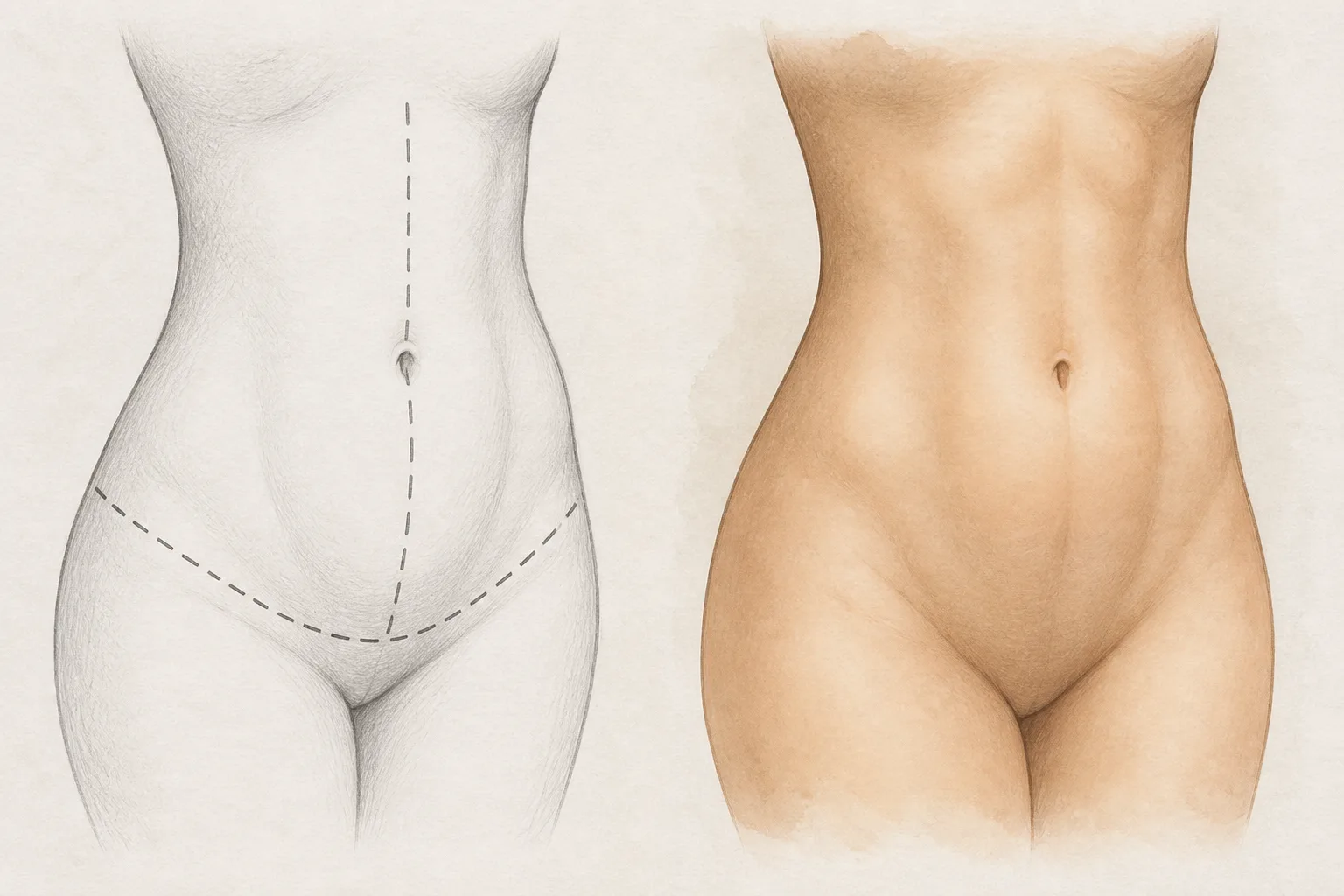
A tummy tuck is designed around excess abdominal skin and, when indicated, laxity of the abdominal wall. The surgeon may remove a lower section of skin, tighten or repair the abdominal wall and reposition the navel in a full procedure. It creates a longer scar than liposuction and has a different recovery. The objective is not simply to make the scale number smaller; it is to improve the abdominal contour when skin and muscle are part of the problem.
Abdominoplasty cannot remove every stretch mark or guarantee a flat abdomen in every position. Skin above the planned excision may remain, and the final result is affected by weight stability, scars, tissue quality and healing. If your concern is a small fat pocket with firm skin and no meaningful laxity, a tummy tuck may be more surgery than you need.
Questions that help distinguish the two
Does the skin hang or fold?
Skin that hangs over underwear, forms a persistent fold or remains loose after weight loss is a reason to ask about skin excision. Liposuction can reduce the fat beneath or around it, but it does not remove the skin envelope. The surgeon should show you what would remain if only fat were treated.
Does the abdomen bulge because of the wall?
Pregnancy and major weight changes can stretch the tissues between the abdominal muscles. A central bulge, doming or core weakness may need assessment for diastasis recti or a hernia. Liposuction does not repair the abdominal wall. If muscle repair is relevant, a tummy tuck or another medical plan may be discussed.
Is the concern distributed around the torso?
Someone with good skin elasticity and fat around the abdomen, flanks and back may discuss a circumferential liposuction plan. However, “360” does not mean every area is treated with the same volume or intensity. Ask which zones are included, what will be left untreated and how the plan changes if one area is unsafe to treat on the same day.
How much change can your skin tolerate?
Skin elasticity is influenced by age, pregnancy, weight changes, genetics and sun damage. Two people with a similar amount of fat can have different results after liposuction. A surgeon should assess the skin while you stand and move, not rely on a single front-facing photograph. If contraction is unlikely to be sufficient, skin removal or a staged strategy may produce a more predictable contour.
Can Lipo 360 and tummy tuck be combined?
Sometimes. Selected patients may have both excess skin and localised fat, and a surgeon may combine limited liposuction with abdominoplasty to refine the waist or flanks. The decision depends on the total area, expected blood loss, operating time, anaesthetic risk, health, smoking status and the surgeon’s technique. More procedures in one session are not automatically better.
A staged plan may be safer or more logical when there is a large amount of fat to address, a significant skin operation or uncertainty about how the skin will settle. Staging can feel slower, but it separates recovery demands and may reduce the amount of surgical trauma in one session. Ask what the surgeon would recommend if safety, rather than package design, were the only priority.
How recovery differs
Liposuction commonly causes swelling, bruising, tenderness and areas of firmness that evolve over time. A compression garment may be prescribed, and walking is usually part of the recovery plan once safe. A tummy tuck can add an incision, wound care, greater tightness, difficulty standing fully upright and restrictions on lifting. If muscle repair is performed, the early feeling of abdominal tension may be more pronounced.
International patients should plan follow-up, garments, medication, airport assistance and help after returning home for either operation. Do not choose liposuction because it sounds like an “easier” holiday procedure or a tummy tuck because a larger operation promises a more dramatic result. The appropriate operation is the smallest plan that addresses the actual problem safely and honestly.
Questions to ask in the consultation
- Is my main issue fat, loose skin, muscle laxity or a combination?
- What would remain if I had Lipo 360 alone?
- Would a tummy tuck leave untreated fullness around my back or flanks?
- Do I have signs of diastasis recti or a hernia?
- Could the procedures be combined safely, or would staging be wiser?
- Which exact areas will be treated and which will not?
- How will the recommendation affect scars, garments, travel and recovery support?
The most useful answer to “Lipo 360 vs tummy tuck” comes after the surgeon identifies the tissue that needs changing. Review the related liposuction operation page and tummy tuck operation page for general context, then ask for a plan based on your anatomy rather than a generic treatment name.
You can also read the ASPS discussion of abdominal procedure choices. Educational information cannot determine which operation is right for you without a clinical examination.